








Robert W. Chambers
The Artist Behind The King in Yellow
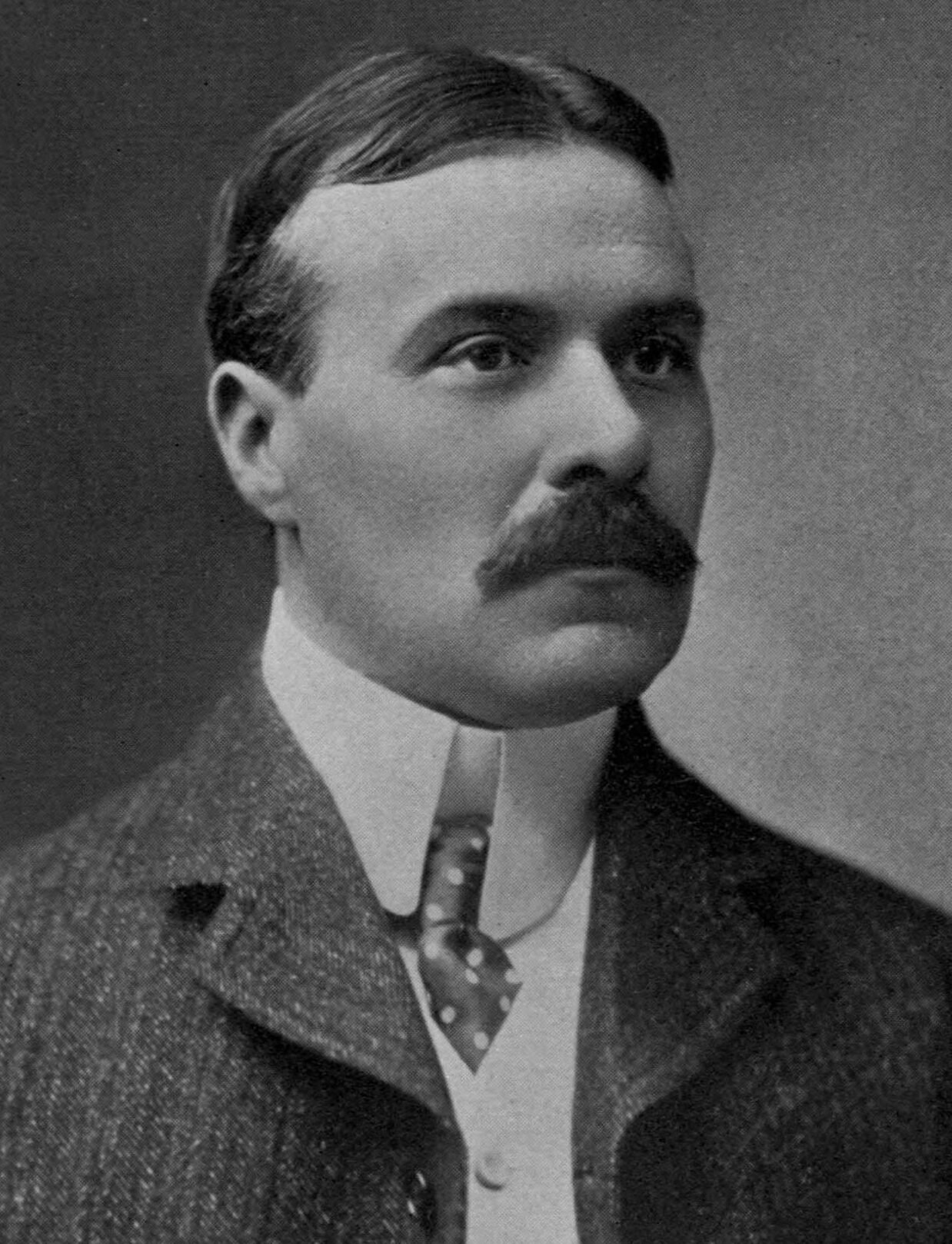
Robert W. Chambers is one of the most peculiar figures in American literary history.
He wrote scores of novels and hundreds of stories. He was a successful commercial author in his own lifetime, known for romance, adventure, society fiction, historical fiction, and tales of modern life. He had trained as an artist, spent formative years in Paris, and knew how to create atmosphere through colour, setting, gesture, and suggestion.
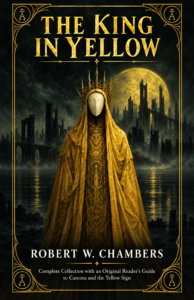
Yet today, he is remembered above all for one slim, strange collection published in 1895: The King in Yellow.
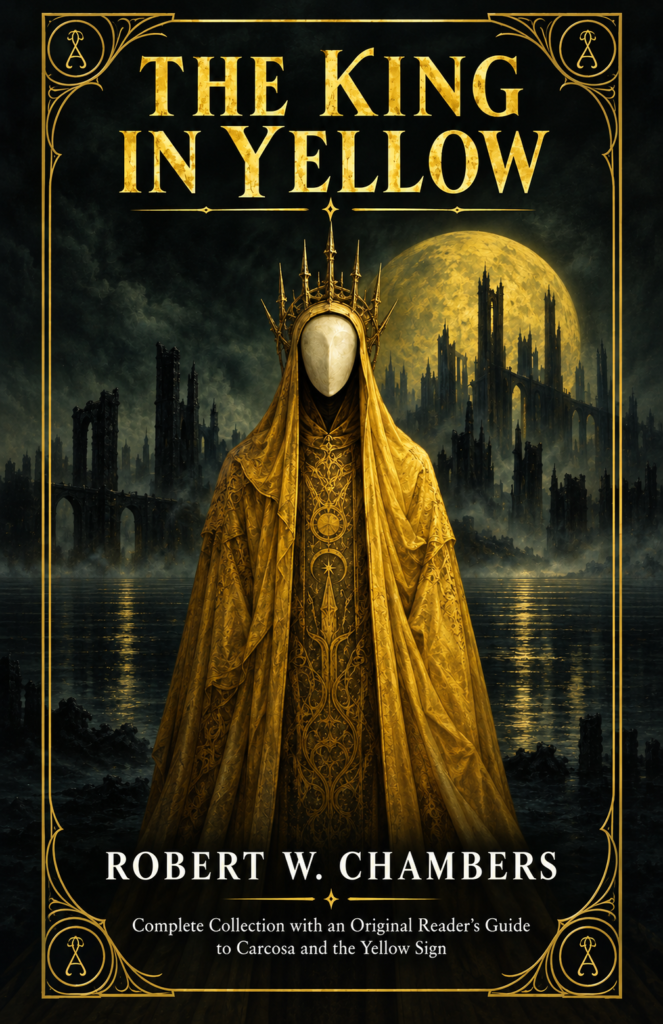
Its reputation rests especially on a handful of unsettling stories connected by a forbidden play, an ancient city called Carcosa, the Yellow Sign, and a figure who is never properly explained. The book has inspired horror writers, game designers, filmmakers, musicians, and readers for more than a century. It influenced H. P. Lovecraft, entered the wider language of cosmic horror, and gained renewed popular attention through works such as True Detective.
But the Chambers behind The King in Yellow is more interesting than the simplified legend. He was not a writer who built a neatly organised mythology with a map, a pantheon, and fixed rules. He was an artist of uncertainty. His greatest effect comes from what he refuses to explain.
The King in Yellow is frightening not because readers are shown everything. It is frightening because they are shown just enough to feel that something much larger is waiting beyond the edge of the page.
The Artist Before the Author
Before he became a bestselling writer, Robert W. Chambers was trained as a visual artist. He studied art in New York and later in Paris, where he encountered the crowded, theatrical, fashionable, and sometimes decadent world of late nineteenth-century European culture.
That background matters.
Chambers writes visually. His stories are filled with rooms, costumes, landscapes, paintings, streets, faces, and colours that do more than decorate the scene. A ruined city under unfamiliar stars, a silent church, a studio apartment, a pale mask, a lake at twilight, or a scrap of yellow cloth can become charged with menace before anything overtly supernatural happens.
He understood that horror is often strongest when it arrives through mood rather than explanation. A reader may not know what a symbol means, but can sense that it is dangerous. A character may describe a place only briefly, but the description remains in the imagination because it feels like a glimpse of something forbidden.
This visual intelligence gives The King in Yellow much of its power. The book is not only about madness, occult knowledge, or supernatural intrusion. It is about seeing something that changes the way the world looks afterward.
A Collection That Refuses to Behave Like a Novel
One of the first things readers should know is that The King in Yellow is a collection of stories, not a single continuous narrative.
That may sound obvious, but it matters because later adaptations and references have often turned “the King in Yellow” into a fully developed horror mythology. Readers may come to the collection expecting a single villain, a clear supernatural world, or a sequence of connected events. Chambers offers something stranger and more elusive.
The first four stories are the dark heart of the book:
- “The Repairer of Reputations”
- “The Mask”
- “In the Court of the Dragon”
- “The Yellow Sign”
These tales share a handful of names, images, and ideas. They refer to a fictional play called The King in Yellow. They evoke Carcosa, Lake Hali, Hastur, masks, strange stars, and the Yellow Sign. But they do not combine these elements into a stable system.
The later stories move away from overt horror and become increasingly romantic, melancholy, or literary in mood. They still belong to the same broad artistic world—full of artists, Parisian settings, longing, beauty, and loss—but they do not continue the same supernatural thread in the way a modern series might.
This shift is not a flaw to be corrected. It is part of the collection’s identity.
The King in Yellow is an anthology of moods. It begins in dread, uncertainty, and psychological collapse; then it opens into romance, memory, and beauty tinged with sadness. Chambers is not giving readers one solved mystery. He is giving them a world in which art and desire may be as destabilising as terror.
The Play That Should Not Be Read
The most famous idea in the collection is the forbidden play also titled The King in Yellow.
Characters who read it—especially its second act—risk madness, despair, obsession, or a terrifying change in perception. The play is referred to repeatedly, quoted only in fragments, and never presented in full. Readers learn that it involves Carcosa, a king in yellow robes, masks, lost identities, impossible knowledge, and a beauty so profound that it becomes unbearable.
The genius of the device is that Chambers does not show us enough of the play to reduce it to an ordinary object.
Had he printed the whole work, readers might judge it as a play: Is it coherent? Is it persuasive? Is it genuinely frightening? Instead, the missing text becomes more powerful than any complete text could be. Every reader imagines a different second act. Every reference to it becomes an invitation to supply the horror personally.
This is one of the great techniques of weird fiction. The forbidden book, document, manuscript, painting, or piece of music is frightening because it creates an empty space in the story. The characters react to something the reader cannot fully see. Their fear becomes evidence, but never certainty.
In Chambers’s hands, the play is not merely cursed. It is a symbol of dangerous understanding.
To read it is to discover that ordinary reality may be only a thin surface. Beneath it may lie another history, another identity, another city, another sky. The reader who encounters the play does not simply learn a secret; they lose the comforting ability to believe that the world is what it seemed.

Carcosa, Hastur, and the Yellow Sign: What Chambers Actually Gives Us
Few names in weird fiction have acquired more weight than Carcosa, Hastur, and the Yellow Sign. Yet much of their apparent certainty comes from later writers and readers, not from Chambers himself.
Carcosa is an ancient, mysterious place associated with the imaginary play. It seems to belong to another world, another time, or another level of reality. It is evoked through images rather than described through geography: towers, a lake, twin suns, black stars, lost cities, masks, and vast distances.
Hastur is even less stable. The name appears, but Chambers does not clearly establish it as a god, monster, place, or force. It has an atmosphere rather than a definition.
The Yellow Sign is similarly powerful because it remains unclear. It is a symbol, but its exact meaning is never nailed down. It appears to bind characters to danger, knowledge, or doom. It may be a mark of recognition. It may be an invitation. It may be evidence that the boundary between Carcosa and the ordinary world has weakened.
Chambers did not invent all these names from nothing. Carcosa, Hali, and Hastur had appeared earlier in the work of Ambrose Bierce. Chambers borrowed them, altered their resonance, and placed them in a new setting of decadent art, forbidden literature, and private dread.
Then Lovecraft and later writers borrowed or transformed some of Chambers’s evocative material again. Over time, the names became part of a much wider imaginative network.
That later development is fascinating, but it can obscure what is special about Chambers’s original work. He is not offering a catalogue of monsters. He is using a few suggestive names as doors into uncertainty.
The less we know about Carcosa, the more it feels like somewhere we should not try to reach.
Beauty, Decadence, and Decay
The word “decadent” is often attached to The King in Yellow, and it is useful if understood correctly.
Decadent fiction is drawn to beauty at the edge of corruption: art that becomes obsessive, refinement that becomes weakness, desire that becomes destructive, and civilisation that appears polished but hides rot beneath the surface. It is fascinated by rare sensations, artificial beauty, fading grandeur, and the possibility that the cultivated mind may be especially vulnerable to ruin.
Chambers’s horror emerges from this atmosphere.
His protagonists are often artists, writers, dreamers, connoisseurs, or people unusually sensitive to beauty. They are not necessarily foolish. In some cases, their sensitivity is precisely what allows them to perceive what ordinary people miss. But perception comes at a cost.
A painting, a face, a melody, a theatrical performance, or a city at dusk can become the first step toward a reality that will not remain safely aesthetic. Art does not merely represent the strange; it can summon it, reveal it, or make the mind receptive to it.
This is why The King in Yellow feels different from later cosmic horror. Lovecraft often turns outward, toward deep time, alien races, indifferent universes, and the collapse of human importance. Chambers often turns inward, toward beauty, obsession, identity, and the terrible intimacy of a mind losing its hold on the familiar.
His horror is less scientific than Lovecraft’s and more aesthetic. It does not always ask, “What is out there?” It asks, “What if beauty itself has become a way in?”
Four Essential Stories
“The Repairer of Reputations”
The opening story is one of the strangest and most influential pieces in the collection. Set in a future America that is both recognisable and deeply distorted, it follows Hildred Castaigne, a man who believes he is entangled in a vast political conspiracy and destined for power.
At the centre of the tale is Mr. Wilde, the “repairer of reputations,” whose knowledge and influence seem almost supernatural. The story blends political satire, psychological instability, aristocratic fantasy, and hints of the forbidden play.
Its brilliance lies in uncertainty. Is Hildred truly uncovering a hidden order, or is he building an elaborate delusion around fragments of reality? Chambers never permits an entirely comfortable answer. The reader is drawn into a consciousness that may be brilliant, paranoid, insane, or all three at once.
“The Mask”
“The Mask” is quieter and more romantic, but its strangeness is no less persistent. Set in Paris, it centres on an artist and his friends, including a sculptor whose unusual discovery can transform living things into marble.
The story is about love, friendship, beauty, jealousy, and the fear of emotional loss. The King in Yellow play is present only at the edges, yet its shadow remains. The tale suggests that art can preserve beauty—but preservation may also mean death, stasis, or the loss of everything that made the beloved person alive.
This is Chambers at his most lyrical. The horror is not a sudden attack. It is the dawning recognition that beauty cannot be held without being changed.
“In the Court of the Dragon”
This is perhaps the most dreamlike of the four central tales. A narrator enters a church and becomes convinced that he is being pursued by an organist whose music seems to carry the force of an ancient curse.
The story moves through sacred space, nightmare logic, fear, and hallucination. Its power comes from its refusal to clarify whether the threat is supernatural, psychological, or both. The narrator’s terror is immediate and convincing, but the world around him becomes increasingly unstable.
“In the Court of the Dragon” is a short lesson in atmosphere. It shows how little Chambers needs to explain in order to create dread. A sound, a face, a doorway, and the suspicion of pursuit are enough.
“The Yellow Sign”
For many readers, “The Yellow Sign” is the most memorable story in the collection. An artist and a young woman become increasingly disturbed by a silent, grotesque figure: the church watchman who appears near their home and seems connected to the dreaded Yellow Sign.
The tale is intimate, almost domestic, which makes its horror more effective. The danger does not arrive through grand cosmic spectacle. It arrives through dreams, a book, an image, a persistent unwanted presence, and the growing awareness that something has entered the characters’ lives.
The story also shows Chambers’s gift for withholding. The watchman is unforgettable precisely because he is not fully explained. He is less a character than an intrusion—something that should not belong in the ordinary world, but does.
Before Lovecraft—and Beyond Lovecraft
It is impossible to discuss The King in Yellow without mentioning H. P. Lovecraft. Lovecraft read Chambers, admired aspects of the collection, and borrowed some names and motifs, including references to Lake Hali and the Yellow Sign.
But Chambers should not be treated simply as a preliminary stage before Lovecraft arrived.
He is a different kind of writer, working through a different emotional register. Lovecraft’s greatest stories often confront the reader with vast, impersonal forces and the smallness of humanity. Chambers’s best stories are more intimate. Their fear is woven through art, romance, private obsession, and the fragility of perception.
Chambers also has a strong connection to the later tradition of psychological and literary horror. His influence can be felt wherever a story uses a forbidden artwork, a half-explained symbol, or an imagined text to unsettle the reader. He helped show that horror could emerge from suggestion, atmosphere, and the collapse of certainty without requiring a fully revealed monster.
The modern afterlife of the Yellow King has often enlarged the mythology. Writers, games, television series, and online communities have given Carcosa, Hastur, and the King a level of detail that Chambers never supplied.
That expansion is part of the legacy. But the original collection remains powerful because it keeps the centre empty.
Chambers gives us the ruined threshold, the yellow rags, the distant towers, the forbidden second act—and leaves us to decide what waits behind them.
How to Read The King in Yellow Today
Readers expecting nine or ten stories of uninterrupted cosmic horror may be surprised by the collection’s changing mood. The best approach is to allow it to be what it is: a deliberately varied book whose strongest horrors are concentrated near the beginning.
Start with the first four stories and read them slowly. Notice the recurring details, but resist the temptation to force them into a complete system. The uncertainty is the point.
Then continue into the later tales with a different expectation. They are not failed versions of “The Yellow Sign.” They reveal Chambers as a broader writer, interested in romance, memory, art, Paris, longing, and the emotional costs of beauty. Their relationship to the opening stories is often one of atmosphere rather than plot.
The collection becomes richer when read this way. The reader begins with forbidden knowledge and dread, then moves through stories in which the supernatural may fade but the emotional unease remains. The King in Yellow does not need to appear on every page. Once the possibility of Carcosa has been introduced, the ordinary world never feels entirely ordinary again.
Reading Chambers Critically
Like many writers of his period, Chambers can present attitudes, language, and social assumptions that modern readers may find uncomfortable or offensive. These elements should be acknowledged rather than ignored.
A classic work can be historically important, imaginative, and influential while still reflecting prejudices of its time. Reading critically means holding both truths at once. It means appreciating Chambers’s atmosphere, craft, and contribution to weird fiction without pretending that every aspect of the work belongs comfortably in the present.
That honest approach does not diminish the collection. It makes for a more attentive reading experience.
Why Robert W. Chambers Endures
Robert W. Chambers endures because The King in Yellow understands a fear that has only become more recognisable with time: the fear that information can change us.
A book, image, symbol, performance, or idea may not merely tell us something new. It may make the old world impossible to return to.
Chambers knew that the most frightening thing is not always a creature in the dark. Sometimes it is the moment when a familiar room, a familiar face, or a familiar life begins to feel unreal. Sometimes it is the discovery that there are names we recognise without knowing why. Sometimes it is the sensation that a door has opened—not in the world, but in the mind.
That is the secret of The King in Yellow.
It is not a completed map of an imaginary universe. It is a handful of clues, images, and whispers arranged so that the reader begins to suspect that the map exists somewhere else.
And perhaps that it is better not to find it.
When Novels Were Released Like a TV Series

Have the Jane Austen Movies Replaced the Books?

Why Jane Austen Remains So Popular

Why I Hate Shakespeare

Whodunit Better
Why did Mark Twain not like James Fenimore Cooper?

Classic Literature Quiz (Part 1): How Well Do You Know the Classics?

Jane Austen vs the Brontë Sisters

100 Editions, Countless Discoveries

What Classic Horror Was Really Trying to Tell Us