
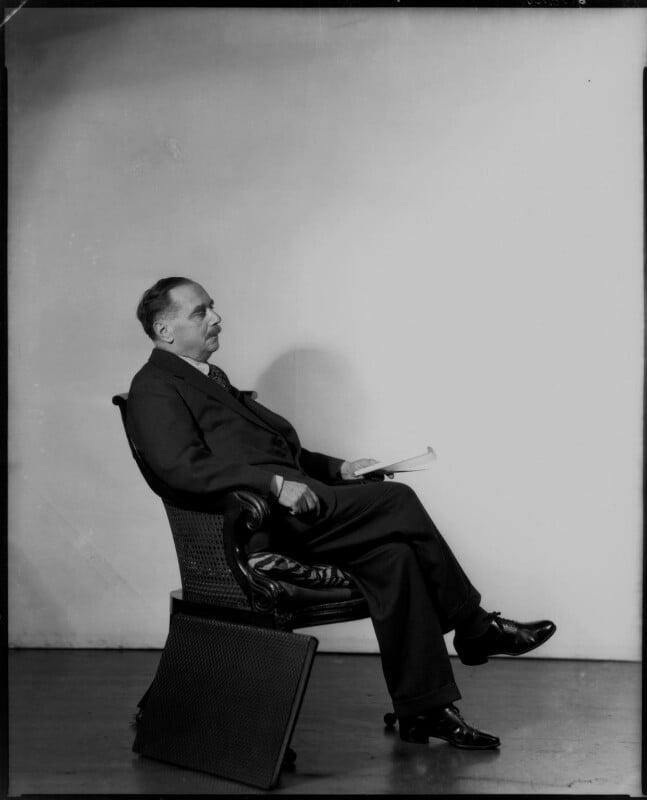









H. G. Wells Didn’t Just Write Science Fiction—
He Wrote About Human Nature
When most people hear the name H. G. Wells, they think of science fiction.
They think of time machines, Martian invasions, invisible men, and strange scientific experiments. They think of futuristic ideas that seemed impossible when Wells first imagined them, yet often feel surprisingly plausible today.
This reputation is well deserved. Few writers have had a greater influence on science fiction. More than a century after his most famous novels were published, filmmakers, authors, and audiences continue to draw inspiration from his ideas. Concepts that Wells helped popularize have become foundational elements of modern science fiction.
Yet focusing only on Wells as a science-fiction pioneer misses something important.
The extraordinary inventions and fantastic scenarios found in his novels were never his true subject.
Wells was not simply interested in technology.
He was interested in people.
He used invisible men, distant futures, scientific experiments, and alien invasions to explore questions about morality, power, class, responsibility, fear, and the darker aspects of human nature. His stories endure because the scientific ideas remain fascinating, but they continue to resonate because the human questions remain relevant.
More than a hundred years after his death, readers still find themselves challenged by the same moral dilemmas, social concerns, and psychological insights that Wells explored throughout his work.
To understand why his novels remain so influential, it helps to begin with the man himself.
H. G. Wells: The Man Who Imagined Tomorrow
Herbert George Wells was born in England in 1866, a period of rapid technological, scientific, and social change.
The Victorian world into which he was born was being transformed by industry, scientific discovery, and expanding global influence. Railways connected cities, factories reshaped economies, and new scientific theories challenged long-held assumptions about humanity’s place in the world.
Perhaps no intellectual development influenced Wells more than Charles Darwin’s theory of evolution.
Darwin’s ideas fundamentally altered how people understood humanity, nature, and the future. If species could evolve over time, what might humanity become thousands or even millions of years in the future? What forces would shape that evolution? Would progress continue indefinitely, or might civilization itself decline?
These questions would later form the foundation of some of Wells’s most famous works.
Unlike many writers of his era, Wells possessed a strong scientific education. He studied biology under Thomas Henry Huxley, one of Darwin’s most influential supporters. This scientific background gave his fiction a credibility that distinguished it from many earlier fantasy and adventure stories.
At the same time, Wells was deeply interested in politics, social reform, education, and economics. He worried about inequality, poverty, unchecked power, and the consequences of technological change.
As a result, his novels often function on two levels.
On the surface, they are exciting stories filled with extraordinary events.
Beneath the surface, they are explorations of human society and human behavior.
This combination helps explain why Wells remains so widely read today.
Readers may initially pick up a Wells novel because they are intrigued by its premise. They continue reading because they discover that the story is really about themselves.
Why H. G. Wells Still Feels Modern
Many nineteenth-century novels feel firmly rooted in their own historical moment.
Wells often feels surprisingly contemporary.
Part of this comes from the remarkable imagination displayed throughout his work. He envisioned technologies, social developments, and scientific possibilities that were decades ahead of their time.
But his continuing relevance extends beyond prediction.
The questions that fascinated Wells remain unresolved.
How should power be used?
What limits should science respect?
Can technological progress solve humanity’s problems?
What happens when social inequality becomes extreme?
How fragile is civilization?
What responsibilities accompany knowledge?
These questions feel just as urgent today as they did when Wells first posed them.
Modern readers may encounter discussions about artificial intelligence, genetic engineering, surveillance technology, social inequality, or global conflict and find echoes of concerns that Wells explored more than a century ago.
This is why his novels continue to appear on bookshelves and reading lists around the world.
The technology changes.
Human nature does not.

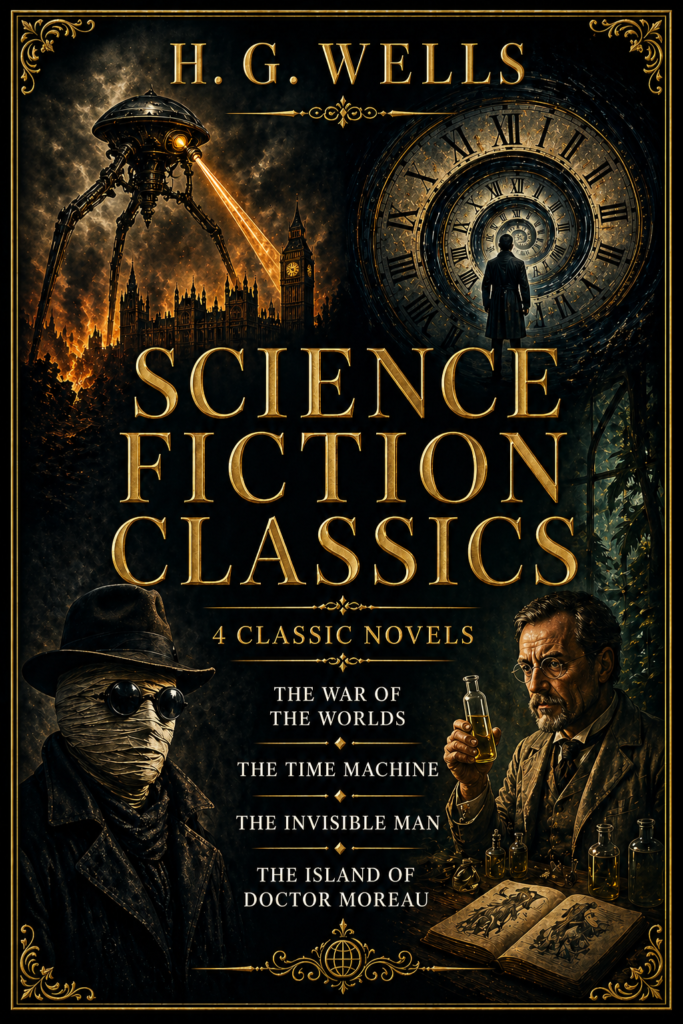
The Time Machine: A Warning About Human Society
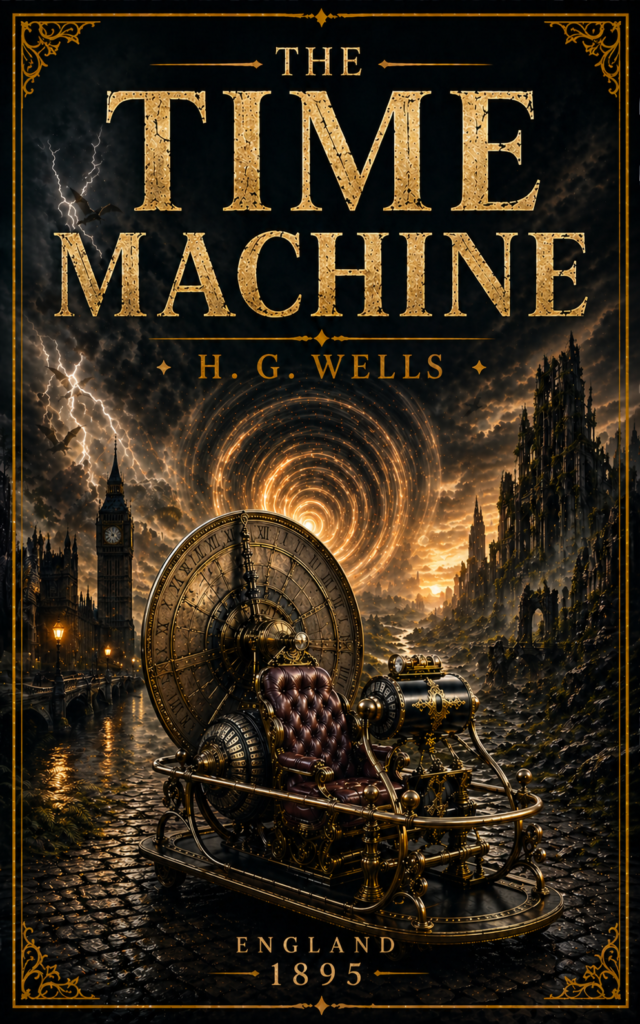
Many readers remember The Time Machine for its extraordinary premise.
A scientist invents a machine capable of traveling through time and journeys hundreds of thousands of years into the future.
The concept remains one of the most influential ideas in all of science fiction.
Yet Wells’s true interest was not the machine itself.
It was what the future revealed.
When the Time Traveller arrives in the distant future, he encounters two very different descendants of humanity: the gentle Eloi and the subterranean Morlocks.
At first, the Eloi appear to represent an ideal civilization. They live without visible conflict, labor, or hardship. Their lives seem peaceful and effortless.
The reality proves far more disturbing.
As the novel unfolds, Wells reveals that the apparent paradise is built upon a deeply troubling social history. The Eloi and Morlocks represent the long-term consequences of class division carried to its ultimate extreme.
The wealthy and privileged have become physically and intellectually diminished through comfort and dependence.
The laboring classes have adapted to lives spent beneath the surface, eventually becoming something entirely different.
The horror of The Time Machine lies not in monsters or violence.
It lies in the possibility that social inequality could fundamentally reshape humanity itself.
Wells used the future as a mirror through which readers could examine the present.
More than a century later, debates about wealth, opportunity, class, and social division remain central to public life, giving the novel a relevance that extends far beyond its science-fiction premise.
The Invisible Man: What Happens When Power Has No Limits?
If The Time Machine explores the dangers of social division, The Invisible Man examines a different question:
What happens when someone gains power without accountability?
The novel’s protagonist, Griffin, achieves one of humanity’s oldest fantasies. Through scientific experimentation, he discovers how to become invisible.
In many stories, such an ability would transform someone into a hero.
Wells chose a different path.
Rather than using invisibility for noble purposes, Griffin becomes increasingly isolated, selfish, manipulative, and violent. Freed from many of the normal consequences of his actions, he gradually abandons the moral restraints that govern ordinary social behavior.
The result is one of Wells’s most compelling studies of human nature.
The true danger in the novel is not invisibility itself.
It is the character of the person who possesses it.
Wells understood that power does not automatically improve people. In many cases, it simply reveals qualities that were already present beneath the surface.
The novel therefore becomes an exploration of responsibility, ethics, and the corrupting influence of unchecked power.
These themes remain remarkably modern. Whether discussing political authority, technological capability, financial influence, or social status, societies continue to grapple with the same question Wells posed through Griffin:
What happens when someone gains power and believes the normal rules no longer apply to them?
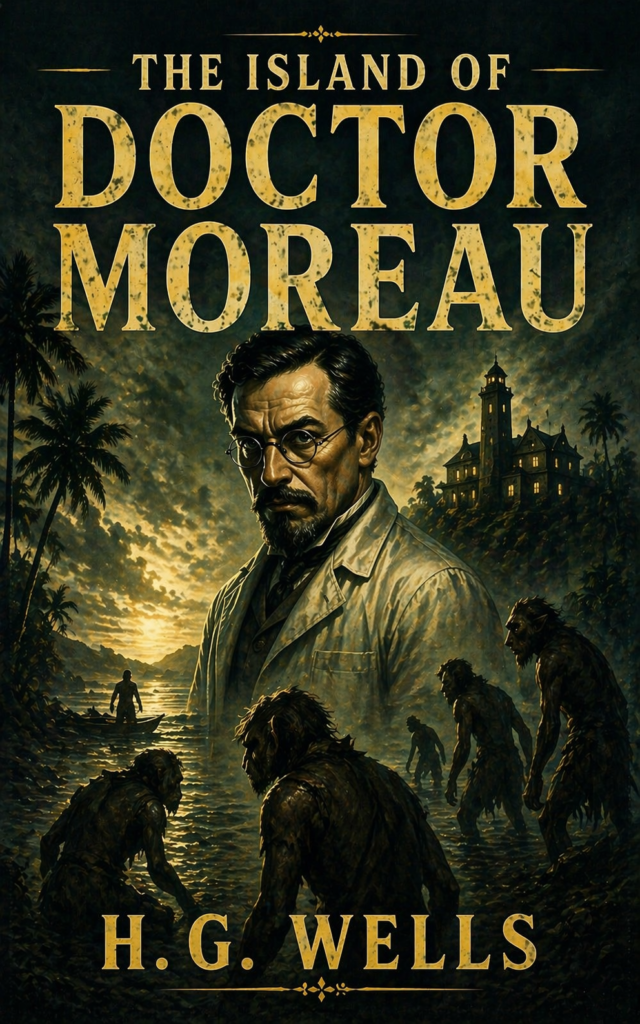
The Island of Doctor Moreau: Science Without Ethics
If The Invisible Man explores what happens when an individual gains unchecked power, The Island of Doctor Moreau asks a different but equally unsettling question:
What happens when scientific curiosity is no longer restrained by morality?
When Edward Prendick finds himself stranded on Doctor Moreau’s remote island, he discovers a place where conventional ethical boundaries have been abandoned. Moreau conducts disturbing experiments designed to transform animals into creatures that resemble human beings. Through surgery, pain, conditioning, and relentless manipulation, he attempts to reshape nature itself.
The resulting creatures are neither fully human nor fully animal.
They exist in an uncomfortable space between the two.
At first glance, the novel appears to be a story about a mad scientist and his horrifying experiments. Yet Wells was interested in much more than shock or spectacle.
The true horror of the novel lies in Doctor Moreau himself.
Moreau represents scientific ambition detached from compassion. He is intelligent, disciplined, and utterly committed to his work, yet he rarely considers the moral implications of his actions. The suffering of his subjects matters less to him than the pursuit of knowledge.
In many ways, Wells anticipated debates that continue today.
As scientific capabilities expand, societies are repeatedly forced to ask difficult questions. Should every experiment be conducted simply because it is possible? What responsibilities accompany scientific knowledge? Where should ethical limits be placed?
These concerns are no longer confined to fiction. Advances in genetics, biotechnology, artificial intelligence, and medical science continue to generate discussions remarkably similar to those Wells explored more than a century ago.
The novel also examines another recurring Wells theme: the thin line separating civilization from savagery.
The Beast Folk struggle constantly against their animal instincts. Their attempts to maintain human behavior gradually collapse as the influence of Moreau’s laws weakens.
The implication is deeply unsettling.
Wells suggests that civilization may be far more fragile than people would like to believe.
The forces that separate humanity from its more primitive impulses require constant effort to maintain.
This combination of ethical questions, psychological insight, and social commentary helps explain why The Island of Doctor Moreau remains one of Wells’s most thought-provoking novels.
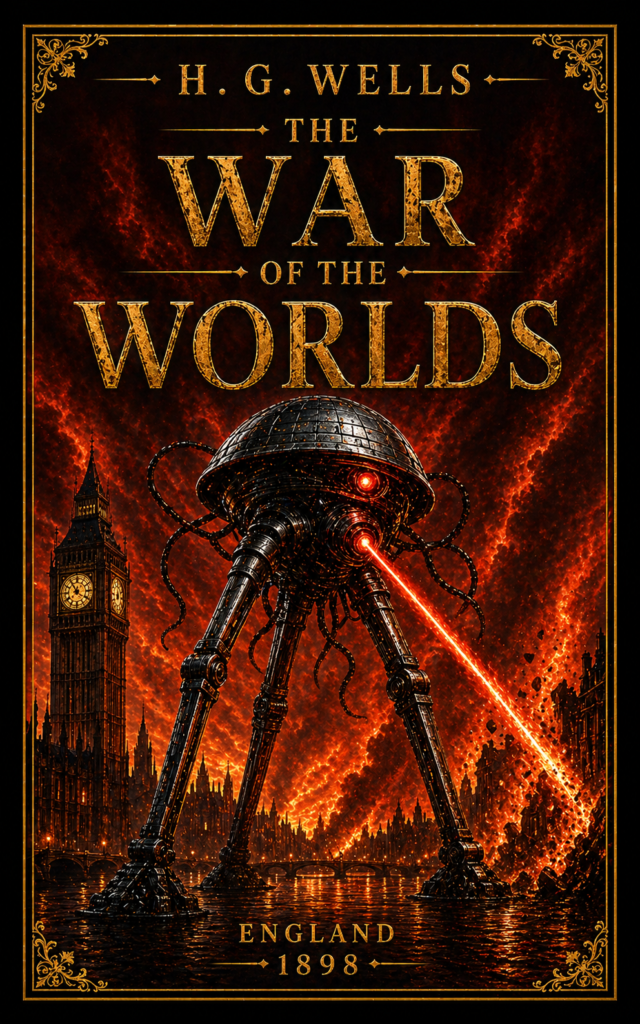
The War of the Worlds: When Humanity Is No Longer in Control
Among all of Wells’s novels, The War of the Worlds may be the one that feels most immediately familiar to modern audiences.
The image of Earth invaded by hostile extraterrestrials has become a cornerstone of science fiction. Countless books, films, television series, and video games owe a debt to Wells’s groundbreaking vision.
Yet once again, the aliens themselves are only part of the story.
The true subject of The War of the Worlds is humanity.
When the Martians arrive, they possess overwhelming technological superiority. Human armies, governments, and institutions prove almost powerless against them. The confidence and security that Victorian society had come to take for granted disappear almost overnight.
For Wells’s original readers, this reversal carried particular significance.
The British Empire was one of the most powerful forces in the world. Britain possessed immense military, economic, and political influence. Many people assumed that this dominance reflected a natural order.
Wells challenged that assumption.
Through the Martian invasion, he invited readers to imagine what it might feel like to become the weaker civilization.
The comparison was deliberate.
Just as European powers had often imposed themselves upon less technologically advanced societies, the Martians treat humanity with similar indifference. Human beings suddenly find themselves on the receiving end of the same logic that had often justified imperial expansion.
This perspective gives the novel a depth that extends far beyond its science-fiction premise.
The story becomes an exploration of vulnerability, survival, and humility.
Wells reminds readers that technological superiority does not guarantee moral superiority.
He also reminds them that human civilization is far less secure than it may appear.
Natural disasters, disease, conflict, and unforeseen events can rapidly disrupt even the most advanced societies.
These themes continue to resonate today, helping explain why The War of the Worlds remains one of the most influential science-fiction novels ever written.
Related Authors
H. G. Wells and the Question of Human Nature
Examining Wells’s major novels together reveals a remarkable pattern.
Although each story explores a different premise, all of them ultimately return to questions about human nature.
In The Time Machine, Wells asks what happens when social inequality becomes entrenched over generations.
In The Invisible Man, he examines the corrupting influence of power without accountability.
In The Island of Doctor Moreau, he questions whether scientific progress can become dangerous when separated from ethical responsibility.
In The War of the Worlds, he challenges assumptions about human superiority and the permanence of civilization.
The extraordinary ideas that made Wells famous are therefore not ends in themselves.
They are tools.
Each fantastic concept allows him to examine human behavior from a new perspective.
The time machine reveals social anxieties.
Invisibility reveals moral weaknesses.
Scientific experimentation reveals ethical dilemmas.
Alien invasion reveals human vulnerability.
This approach helps explain why Wells remains relevant.
Many science-fiction predictions eventually become outdated.
Many technological forecasts prove inaccurate.
Human nature, however, changes far more slowly.
The questions Wells asked continue to matter because people continue to struggle with the same ambitions, fears, weaknesses, and responsibilities.
Why Readers Still Return to Wells
More than a century after their publication, Wells’s novels continue to attract new readers.
Part of this appeal comes from their imagination.
The ideas remain fascinating. Time travel, invisibility, alien invasions, and radical scientific experimentation continue to capture the imagination.
But imagination alone does not explain Wells’s longevity.
Many writers have produced inventive concepts that later faded into obscurity.
Wells endured because his stories combine imagination with insight.
Readers may begin a Wells novel because they are intrigued by the premise.
They continue because they discover deeper questions beneath the surface.
His books encourage readers to think about power, morality, progress, responsibility, and society. They challenge assumptions and provoke reflection.
They also remain remarkably readable.
Wells understood how to tell a compelling story. His novels move quickly, create suspense, and maintain a strong sense of momentum. The philosophical ideas emerge naturally through the narrative rather than overwhelming it.
As a result, readers can enjoy the books on multiple levels.
They can appreciate the adventure.
They can enjoy the science-fiction concepts.
Or they can engage with the deeper themes.
The greatest works often allow all of these experiences simultaneously.
Conclusion: More Than a Science-Fiction Pioneer
H. G. Wells unquestionably helped shape modern science fiction.
Without his influence, the genre would look very different.
His visions of time travel, alien invasion, invisibility, and scientific experimentation inspired generations of writers, filmmakers, and thinkers.
Yet reducing Wells to a science-fiction pioneer alone overlooks the reason his novels continue to matter.
The machines, monsters, and Martians are memorable.
The questions are unforgettable.
What happens when power goes unchecked?
How should scientific knowledge be used?
How fragile is civilization?
What responsibilities accompany progress?
How well do we truly understand ourselves?
These are the concerns that lie at the heart of Wells’s fiction.
More than a century after he first explored them, readers continue searching for answers.
That is why H. G. Wells remains relevant.
That is why his books continue appearing on bookshelves around the world.
And that is why, despite the extraordinary inventions and imaginative premises that made him famous, H. G. Wells did not just write science fiction.
He wrote about human nature.
Articles

When Novels Were Released Like a TV Series

What Classic Horror Was Really Trying to Tell Us

100 Editions, Countless Discoveries

Whodunit Better

Why Jane Austen Remains So Popular

Have the Jane Austen Movies Replaced the Books?

Why I Hate Shakespeare
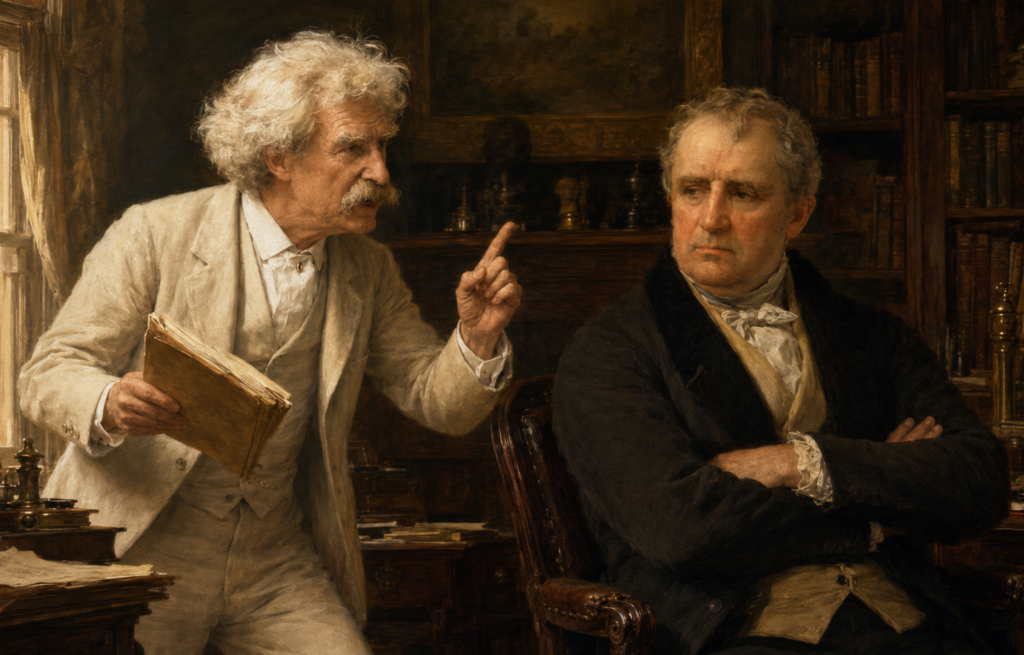
Why did Mark Twain not like James Fenimore Cooper?

Jane Austen vs the Brontë Sisters

Classic Literature Quiz (Part 1): How Well Do You Know the Classics?