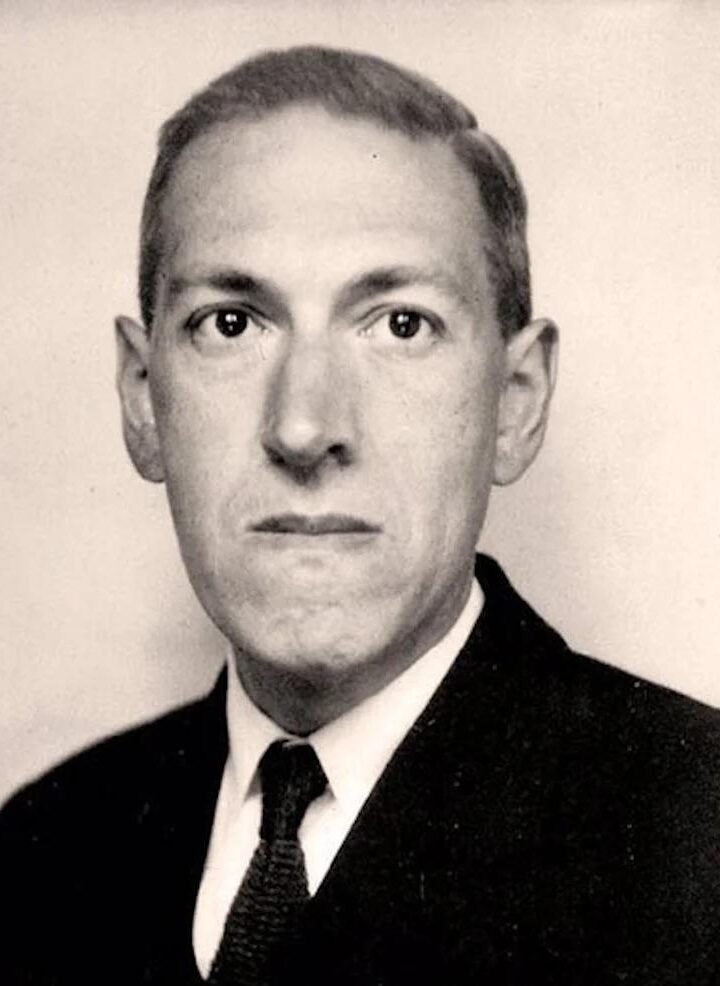









H. P. Lovecraft
The Writer Who Made the Universe Terrifying
H. P. Lovecraft gave horror one of its most enduring modern ideas: the universe does not hate humanity.
It simply does not care.
Before Lovecraft, supernatural horror often centred on ghosts, curses, vampires, murderers, devils, haunted houses, and the consequences of forbidden acts. Lovecraft could use all of these ingredients, but he made the fear larger. His characters do not merely discover that evil exists. They discover that human beings are small, recent, fragile creatures living in a universe immeasurably older and stranger than their religions, sciences, and instincts had prepared them to imagine.
A Lovecraft story may begin with a missing document, an eccentric scholar, an old New England town, a crumbling house, or a scientific expedition. It often proceeds through letters, diary entries, rumours, photographs, interviews, and half-reliable testimony. Slowly, the evidence builds. The reader begins to suspect that something has survived from before humanity—or that humanity itself has never understood its true place in the world.
Then comes the real horror.
It is not simply the appearance of a monster. It is the collapse of the belief that the world was made at a scale human beings can understand.
That idea—now often called cosmic horror—has shaped modern literature, film, television, games, music, comics, and tabletop role-playing. Yet the popularity of Cthulhu imagery can make it easy to forget how strange, subtle, and carefully constructed Lovecraft’s original stories are.
To read Lovecraft well is to look beyond tentacles, cults, and famous names. It is to encounter a writer who turned curiosity itself into a source of dread.
A Life of Reading, Correspondence, and Imagination
Howard Phillips Lovecraft was born in Providence, Rhode Island, in 1890. Providence remained the emotional centre of his life and imagination. Its old streets, colonial houses, graveyards, hills, libraries, and sense of accumulated history helped shape the fictional landscapes of his work.
Lovecraft was fascinated from an early age by science, astronomy, antiquity, mythology, history, and strange tales. He read widely and developed a powerful attachment to eighteenth-century language, old architecture, and the idea of inherited cultural memory. He did not follow a conventional academic or professional path, but he became deeply involved in amateur journalism and later in the world of pulp magazines.
His financial life was often difficult. He wrote comparatively little fiction by the standards of many professional authors, revised and ghostwrote work for others, and never achieved major commercial success during his lifetime. His stories appeared mainly in magazines such as Weird Tales, where they found a small but devoted audience.
He was, however, an extraordinarily active correspondent. Lovecraft wrote thousands of letters, exchanging ideas, criticism, encouragement, jokes, and fictional inventions with a wide circle of writers and fans. Those letters helped create what later became known as the Lovecraft Circle: a loose network of authors who read one another’s work, borrowed fictional names and places, and helped keep weird fiction alive.
Lovecraft died in Providence in 1937, aged forty-six. He had reason to believe that his work would soon be forgotten.
Instead, it grew.
What Is Cosmic Horror?
Cosmic horror is often misunderstood as horror set in space, or horror involving large monsters. Lovecraft’s version is more unsettling than either definition suggests.
Cosmic horror begins with the possibility that humanity is not central to existence.
The universe may be ancient beyond comprehension. Life may have appeared and vanished countless times before human beings existed. The forces that shape reality may not be moral, personal, or even recognisable as living in any human sense. Human knowledge may be useful within ordinary life while remaining almost meaningless against the true scale of time and space.
This does not mean that Lovecraft’s stories are simply pessimistic. They are driven by awe as much as fear. His characters are often scholars, scientists, artists, explorers, or curious readers because Lovecraft understood the thrill of wanting to know more. The danger lies in the fact that knowledge may not be comforting.
A character investigates because an explanation is needed. The evidence seems manageable at first: a strange object, an old book, an unusual biological specimen, a folk belief, a weathered ruin. But each answer opens another question. The familiar categories of religion, science, history, and psychology begin to fail.
What seemed impossible becomes possible.
What seemed possible becomes inadequate.
The horror is the moment when the mind understands enough to know that it cannot understand the whole.
The Art of the Fragment
Lovecraft rarely tells a story in a straightforward, all-knowing voice. Instead, he builds horror through fragments.
A narrator may inherit a box of papers. A university professor may examine an old manuscript. A traveller may listen to a story told by a frightened local. A police report may preserve only part of what happened. A journal may end abruptly. A photograph may be unclear. A witness may be dismissed as mad, drunk, ignorant, or unreliable.
This method gives Lovecraft’s fiction its documentary feel.
The reader becomes an investigator, sorting through imperfect evidence. The effect is powerful because it makes the impossible appear almost plausible. If several independent sources mention the same name, the same ritual, the same location, or the same inexplicable event, the reader begins to feel that the truth must exist somewhere beyond the story’s limits.
Lovecraft understood that complete explanation can weaken horror. A fully described monster can be measured. A fully explained mystery can be filed away. But a half-seen shape, an ancient name, a corrupted document, or a terrified witness can continue working in the imagination long after the story ends.
This is why his stories often feel larger than their actual length. The page contains only fragments. The reader supplies the vastness.
The Cthulhu Mythos: A Shared World, Not a Fixed Rulebook
Cthulhu is Lovecraft’s most famous creation, but Cthulhu is not the whole of Lovecraft.
The creature appears centrally in “The Call of Cthulhu,” where it lies dormant in the drowned city of R’lyeh and becomes the focus of cult worship, dreams, and fear across the world. Its image has become so widely used that it now functions almost as a symbol for Lovecraftian horror itself.
But Lovecraft’s fiction is broader, stranger, and less neatly organised than the popular image suggests.
He did not create a fixed franchise bible with an official hierarchy of gods, monsters, and rules. Instead, he and his friends shared details freely: imaginary books such as the Necronomicon, invented towns such as Arkham and Dunwich, strange entities, obscure names, and recurring institutions such as Miskatonic University.
One writer might mention an idea invented by another. A name could appear in a story without receiving a full explanation. A later tale might change its meaning, ignore it, or use it only as atmosphere.
The phrase “Cthulhu Mythos” itself became widely established after Lovecraft’s death, particularly through the work of August Derleth, who edited, published, and expanded Lovecraft-related fiction. Later authors, artists, game designers, and filmmakers added still more layers.
That continuing creativity is part of the mythos’s appeal. But it is worth distinguishing the later shared universe from Lovecraft’s original stories.
Lovecraft’s own work is not about mastering a lore system. It is about encountering hints of a reality that resists mastery.
The reader does not need to memorise every name. In fact, the less certain the reader feels, the closer they are to the intended experience.
New England, Invented and Remembered
Lovecraft’s cosmic horror often begins close to home.
His fictional New England is full of decaying ports, isolated villages, old families, colonial architecture, university libraries, and rumours that have survived because no one dared examine them too closely. Arkham, Dunwich, Innsmouth, Kingsport, and other invented places feel convincing because they are built from real regional history, geography, and atmosphere.
These places are not merely backdrops. They are pressure chambers.
In Lovecraft’s New England, the past never disappears. It remains in family records, local legends, deteriorating houses, buried objects, church documents, coastal trade routes, and people who know more than they should. A modern investigator may arrive with education, scepticism, and scientific language, only to discover that the landscape has been holding a secret for centuries.
This local grounding makes the cosmic elements more frightening. The ancient and alien do not appear in some unreachable galaxy. They emerge in a quiet town, an inherited house, a university archive, or a road taken by mistake.
Lovecraft’s great trick is to make the ordinary world feel like the visible surface of something much older.
Four Essential Stories
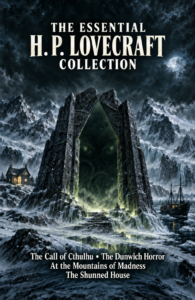
For readers looking for a strong way into Lovecraft’s work, four stories reveal the range of his imagination especially well.
The Call of Cthulhu
“The Call of Cthulhu” is Lovecraft’s most famous story and the clearest introduction to his method of layered evidence.
After the death of a relative, Francis Wayland Thurston inherits a collection of puzzling documents: a strange bas-relief, a sculptor’s disturbing dreams, accounts of a secret cult, and reports of a brutal encounter at sea. As he compares the fragments, he discovers that they point toward Cthulhu, an ancient being sleeping beneath the ocean in the submerged city of R’lyeh.
The story’s lasting power lies in its structure. Cthulhu is not introduced through a simple confrontation. The reader reaches it through testimony, artefacts, newspaper clippings, and fear. By the time the story turns toward R’lyeh, the possibility of the impossible has already been made disturbingly believable.
The Dunwich Horror
“The Dunwich Horror” brings cosmic terror into rural New England.
In the isolated village of Dunwich, the strange and impoverished Whateley family hides a terrible secret. Their youngest member, Wilbur, grows at an unnatural rate, seeks forbidden knowledge, and becomes connected to something that does not belong in the human world.
The story combines folklore, decaying rural isolation, occult scholarship, inherited corruption, and an invisible horror that becomes increasingly difficult to contain. It is also one of Lovecraft’s most direct and dramatic stories, with Miskatonic University scholars drawn into a confrontation that is both grotesque and strangely moving.
At its centre lies one of Lovecraft’s recurring fears: that human identity may be less secure than it appears.
At the Mountains of Madness
At the Mountains of Madness is Lovecraft at his grandest.
Presented as the warning of a survivor, the novella follows an Antarctic scientific expedition that discovers ruins, fossils, and evidence of an ancient civilisation older than humanity. As the explorers travel farther into the frozen continent, they uncover a history of life on Earth that makes human history seem brief and accidental.
The story is not merely about monsters in the snow. It is about scientific discovery becoming too successful. The expedition finds evidence. The evidence is real. The horror lies in what the evidence means.
Lovecraft’s Antarctica is a landscape of scale: ice, mountains, ruins, darkness, distance, and time beyond human measurement. The cold does not simply create atmosphere. It becomes part of the story’s cosmic indifference. Nature is vast, beautiful, and entirely unconcerned with whether the explorers are prepared for the truth.
The Shunned House
“The Shunned House” brings Lovecraft’s horror back to the intimate scale of an old home.
Set in Providence, the story follows a narrator determined to confront the malign presence that has haunted a decaying house for generations. The horror is rooted in local history, family decline, sickness, memory, and something beneath the building that seems less like a traditional ghost than an unnatural contamination.
This makes The Shunned House an especially revealing Lovecraft tale. It combines the Gothic haunted-house tradition with a more biological and cosmic unease. The evil is not simply a dead person refusing to leave. It is ancient, persistent, and difficult even to classify.
The house becomes a symbol of Lovecraft’s wider method: beneath a familiar structure lies something that has always been there, waiting for someone curious enough to disturb it.
Science at the Edge of the Unknown
Lovecraft is sometimes described as anti-scientific because his stories involve madness, monsters, and impossible realities. In fact, his horror depends heavily on scientific language and scientific curiosity.
His protagonists measure, classify, excavate, analyse, compare, and theorise. They are geologists, historians, doctors, professors, artists, collectors, and amateur investigators. They want proof.
Lovecraft’s terror does not come from rejecting reason. It comes from pushing reason to its limits.
The scientist in a Lovecraft story is not punished for irrational superstition. He is often punished for following evidence honestly. The more carefully he studies the world, the more clearly he sees that human theories are incomplete.
This gives Lovecraft’s fiction a distinctive mood. His stories can feel like adventure, detective fiction, scientific romance, Gothic horror, and philosophical speculation at once. The unknown is frightening because it is not random. It has patterns. The problem is that the patterns belong to a reality larger than human minds can comfortably hold.
Why Lovecraft Still Endures
Lovecraft’s influence is now everywhere.
It can be found in literary horror, fantasy, science fiction, graphic novels, heavy music, video games, films, television, and tabletop role-playing games. It appears in stories about ancient gods, forbidden books, cults, impossible architecture, deep-sea terror, hostile planets, inherited secrets, and the limits of sanity.
But his influence is deeper than a list of familiar images.
He gave later creators a language for existential unease. He showed how horror could arise from scale, indifference, and the collapse of human certainty. He made the unknown feel not merely dangerous, but conceptually destabilising.
Modern writers have adapted, challenged, expanded, and transformed his ideas. Many have taken cosmic horror in new directions, using it to explore race, colonialism, environmental destruction, gender, trauma, technology, and the fear of systems too large for individuals to control.
That ongoing reinvention is proof that Lovecraft’s central imaginative insight remains powerful: the world may contain truths that make our ordinary confidence feel very small.
Reading Lovecraft Critically
Lovecraft’s literary importance does not erase his racism and xenophobia.
His letters contain explicitly racist, anti-Black, anti-Semitic, and anti-immigrant views. These beliefs were severe, harmful, and connected to some of the fears and imagery in his fiction. Readers may encounter language, characterisations, and assumptions that are offensive and distressing.
This should be acknowledged plainly.
It is not necessary to pretend that Lovecraft’s prejudices were harmless products of his time, nor is it necessary to deny his influence in order to condemn them. Both facts are true: he was one of the most influential horror writers of the twentieth century, and he held deeply racist beliefs that remain morally indefensible.
Reading Lovecraft critically means recognising that his fears were not purely cosmic or abstract. They were sometimes shaped by real-world prejudices about race, immigration, class, and social change. Modern writers and readers have responded in different ways: some reject his work, some engage with it critically, and others reclaim or transform cosmic horror from perspectives Lovecraft could not have imagined.
A serious understanding of his legacy makes room for that complexity.
Where to Begin
The best way to begin with Lovecraft is not to try to learn an entire mythology at once. Begin with the stories.
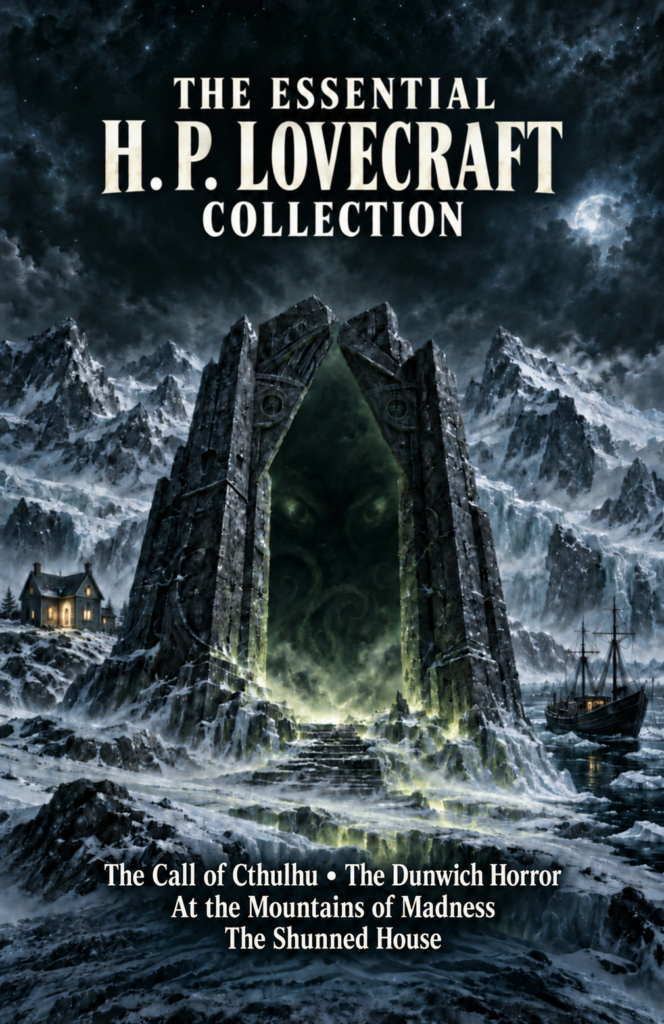
Read The Call of Cthulhu for the foundational experience of piecing together an impossible truth. Read The Dunwich Horror for rural dread, forbidden inheritance, and a more direct confrontation with the unknown. Read At the Mountains of Madness for the full sweep of Lovecraft’s scientific imagination and cosmic scale. Read The Shunned House for an intimate, local horror rooted in history and decay.
Together, these four works show why Lovecraft endures.
They reveal a writer who could make a basement feel ancient, a village feel alien, an expedition feel doomed, and a document feel dangerous. They show that horror does not require darkness alone. Sometimes it begins with a question, an unexplained fact, and the decision to keep looking.
That is Lovecraft’s lasting challenge to the reader:
The universe is larger than you thought.
How much do you really want to know?

Classic Literature Quiz (Part 1): How Well Do You Know the Classics?

Jane Austen vs the Brontë Sisters

Have the Jane Austen Movies Replaced the Books?

100 Editions, Countless Discoveries

What Classic Horror Was Really Trying to Tell Us
When Novels Were Released Like a TV Series

Why Jane Austen Remains So Popular

Why I Hate Shakespeare
Whodunit Better
Why did Mark Twain not like James Fenimore Cooper?